
 V-Belts
 Ribbed/Poly-V Belts
 Timing/Synchronous
 Banded Belts
 Special Belts
 Couplings
 Tensioners and Idlers
 PIX-Collapsible-Belt Length Measure
 PIX-Belt Drive Service Kit
 PIX-Digital Tension Meter
 PIX-X'Align Lasertool
 PIX-Belt Length Measure
 PIX-Analog Tension Tester
 PIX-Belt Profile Gauge
 PIX-Pulley Gauges
 PIX-Pulley Guage Banded Belts
 PIX-Pentagon Poly-V Belts Wear Gauge
 PIX-Pentagon Timing Belt Wear Gauges
 PIX-X'Slit Belt Cutting Machine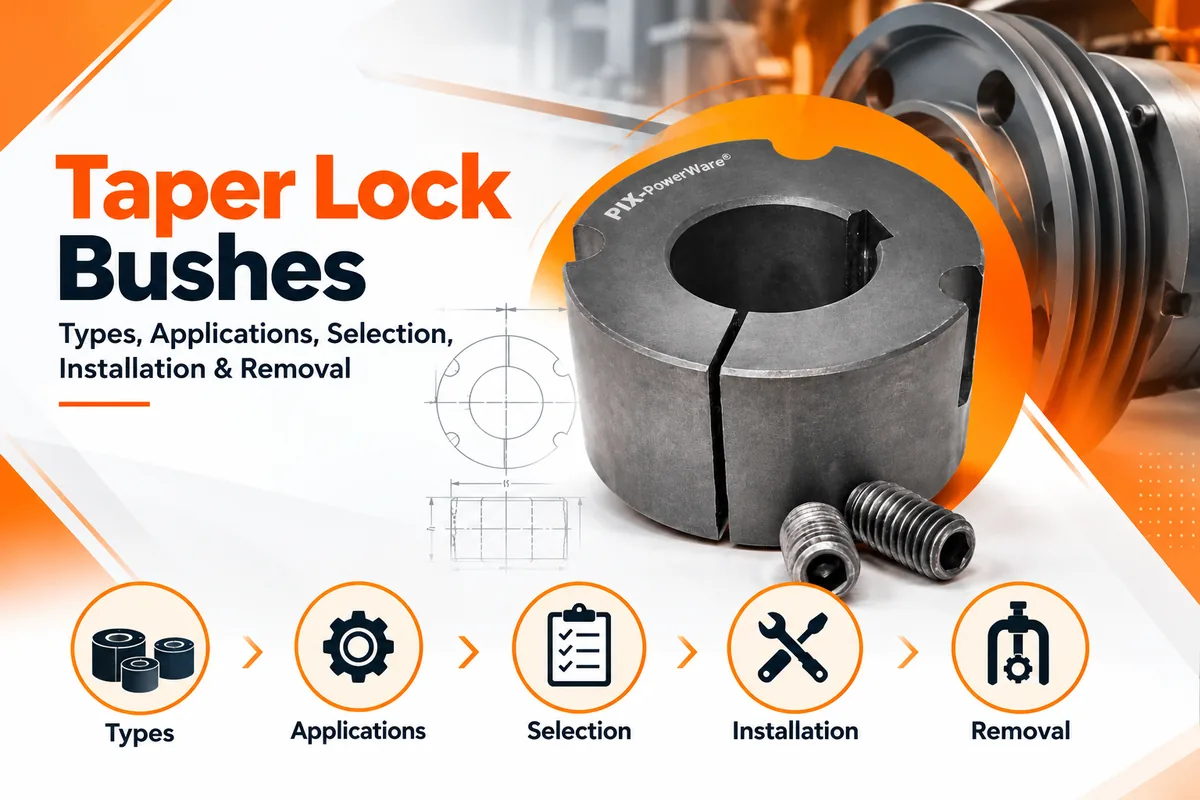
Introduction to Taper Lock Bushes
Taper Lock Bushes are precision-engineered mechanical components designed for secure and efficient mounting of pulleys, sprockets, gears, couplings, and other power transmission components onto shafts. Their tapered design provides a firm, concentric grip, ensuring reliable torque transmission while minimizing shaft damage. Easy to install and remove, Taper Lock Bushes eliminate the need for keyway machining in many applications and simplify maintenance and replacement. Manufactured to high dimensional standards, they offer excellent clamping performance, durability, and operational reliability. Ideal for a wide range of industrial applications, Taper Lock Bushes provide a flexible, cost-effective solution for modern power transmission systems.
Taper Lock Bush – Definition, Construction & Purpose
A Taper Lock Bush is a precision-engineered mechanical component used to securely mount pulleys, sprockets, gears, couplings, and other power transmission components onto shafts. It features a tapered outer surface, a bored inner diameter, keyway, and fixing/removal holes. The tapered construction provides a strong, concentric grip between the bush, hub, and shaft, ensuring efficient torque transmission. Designed for easy installation and removal, Taper Lock Bushes simplify maintenance and component replacement without extensive shaft machining. Manufactured from durable materials such as cast iron or steel, they provide reliable performance, accurate alignment, and secure shaft-to-hub connections across diverse industrial applications.
Tapered Locking Principle
The tapered locking principle uses the wedge effect of two matching tapered surfaces to create a secure connection between a shaft, bush, and mounted component. As the Taper Lock Bush is drawn into the matching tapered bore of the hub using fixing screws, the bush moves axially and generates strong radial clamping pressure around the shaft. This frictional grip securely locks the hub to the shaft and enables efficient torque transmission. The design also ensures accurate concentricity and reduces movement during operation. Releasing the designated removal screws separates the tapered surfaces, allowing quick and convenient dismantling without damaging the shaft or mounted component.
Bush, Shaft, Hub/Pulley & Key
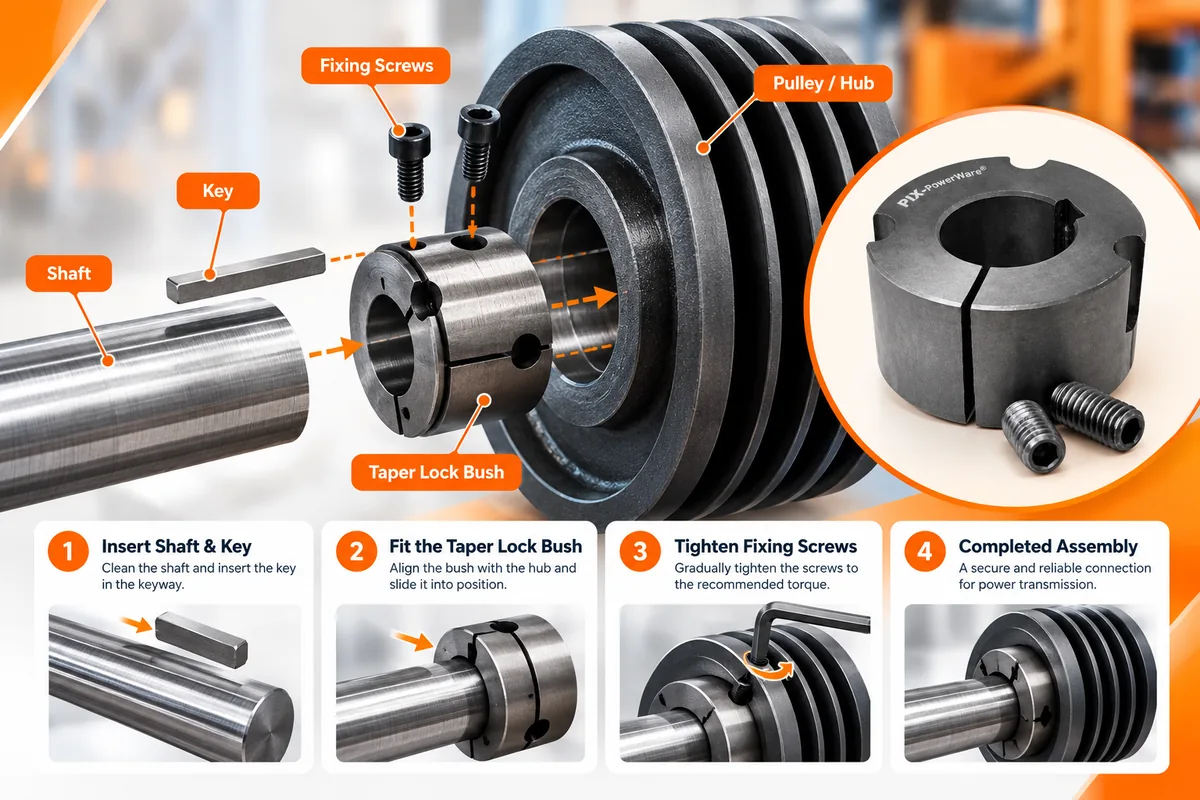
A bush is a precision component fitted between the shaft and hub, providing a secure and detachable connection. The shaft is the rotating element that carries and transmits mechanical power to other components. The hub or pulley is mounted onto the bush and transfers rotational motion and torque through the belt or other drive element. A key is a small mechanical element positioned in matching keyways in the shaft and bush, preventing relative rotation and enabling positive torque transmission. Together, the bush, shaft, hub/pulley, and key form a reliable, accurately aligned connection that facilitates easy assembly, removal, and maintenance.
Taper Lock Bush – Common Configurations & Sizing
Taper Lock Bushes are available in a variety of sizes, bore diameters, and configurations to suit different shaft and power-transmission requirements. Common configurations include standard metric and imperial bore sizes, with or without keyways, and different flange and taper arrangements. Taper Bush sizes are generally identified by a designated bush number, while the bore diameter corresponds to the shaft size. Selection depends on shaft diameter, transmitted torque, hub dimensions, and application requirements. Standardised dimensions enable easy interchangeability across pulleys, sprockets, gears, and couplings. Proper sizing ensures secure locking, accurate alignment, reliable torque transmission, and convenient installation and removal.
Applications of Taper Lock Bushes
Taper Lock Bushes are widely used in power transmission systems to securely mount rotating components onto shafts. They are commonly used with pulleys in belt drives for reliable power transmission, sprockets in chain drives for efficient motion transfer, and couplings for connecting shafts while simplifying assembly and maintenance. They are also extensively used in industrial machinery, including conveyors, pumps, compressors, fans, blowers, agricultural equipment, and material-handling systems. Their easy installation, secure locking, accurate alignment, and quick removal make Taper Lock Bushes a versatile solution for demanding mechanical applications.
Advantages of Taper Lock Bushes
Taper Lock Bushes offer several advantages in power transmission applications. Easy installation and removal reduce assembly time and simplify equipment maintenance. Their secure taper-locking design provides reliable clamping and effective torque transmission without requiring extensive shaft machining. Simplified maintenance allows pulleys, sprockets, couplings, and other components to be quickly replaced when required, reducing downtime. Standardised dimensions provide excellent interchangeability, allowing the same bush type to be used with different compatible components and shaft sizes. Proper Taper Bush Maintenance also helps ensure accurate alignment, secure operation, and dependable performance, making Taper Lock Bushes a practical and cost-effective solution for industrial machinery and drive systems.
How to Select the Right Taper Lock Bush
Selecting the correct Taper Lock Bush requires considering several key factors:
- Bore: Match the bush bore accurately with the shaft diameter to ensure proper fit and secure clamping.
- Shaft: Check the shaft diameter, tolerance, and available keyway dimensions for compatibility.
- Keyway: Ensure the bush keyway matches the shaft keyway for positive torque transmission.
- Hub: Verify that the bush's outside diameter and taper are compatible with the pulley, sprocket, coupling, or hub.
- Load: Consider transmitted power, torque, speed, and operating conditions to select a bush with adequate load-carrying capacity.
Correct selection ensures secure locking, reliable torque transmission, easy maintenance, and long service life.
Taper Lock Bush – Installation & Removal Procedure
Installation
- Clean the shaft, bore, bush, and mating taper surfaces. Remove dirt, rust, and oil.
- Align the bush with the hub and insert it into the tapered bore.
- Insert the key into the shaft keyway and ensure proper alignment.
- Fit the fixing screws into the mounting holes and tighten them alternately and gradually to the manufacturer's specified torque.
- Check that the bush and hub are properly seated and securely locked.
Removal
- Stop and isolate the machine before starting work.
- Remove the fixing screws completely.
- Reinsert the screws into the designated removal holes in the bush.
- Tighten the screws alternately to release the bush from the tapered hub.
- Remove the bush, key, and mounted component carefully, avoiding damage to the shaft or hub.
Problems & Maintenance of Taper Lock Bushes
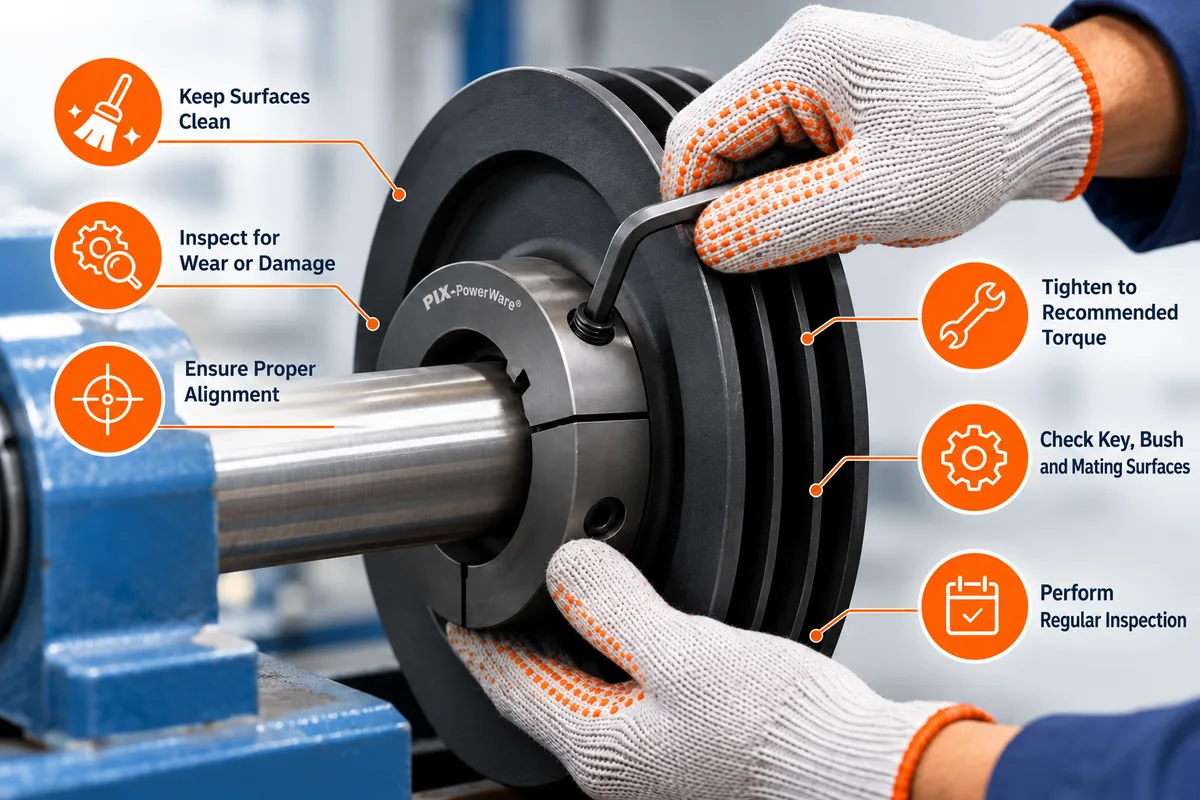
Proper installation and regular maintenance are essential for reliable Taper Lock Bush performance. Taper Bush Installation must be carried out correctly, as loosening may occur due to incorrect tightening, vibration, or improper seating, potentially causing slippage and shaft damage. Wear on the bush, keyway, or mating surfaces can result from excessive loads, misalignment, or prolonged operation. Incorrect installation, such as inadequate cleaning, improper key positioning, or incorrect screw tightening, can reduce clamping efficiency and affect torque transmission. Regularly inspect the bush, shaft, key, and hub for wear, cracks, or damage. Ensure correct alignment, tightening torque, and cleanliness to minimise downtime and extend component life.
What is a taper bush?
A taper bush is a mechanical component that securely mounts pulleys, sprockets, gears, and couplings onto shafts for reliable torque transmission.
Types of Taper Bushes
Common types of taper bushes include:
Standard Taper Lock Bushes – widely used for pulleys, sprockets, and couplings.
Metric Taper Bushes – designed for metric shaft and bore dimensions.
Imperial Taper Bushes – designed for inch-based shaft sizes.
Flangeless Taper Bushes – compact designs for space-constrained applications.
Conclusion
Taper Lock Bushes offer a secure and reliable solution for mounting pulleys, sprockets, gears, and couplings onto shafts. With easy installation, removal, accurate alignment, and dependable torque transmission, they are a practical choice for industrial power transmission applications. Proper selection, installation, and regular maintenance help ensure long-lasting performance and minimise downtime.
Choose the Right Taper Lock Bush for Your Application. Explore the PIX Trans Range for Reliable Power Transmission and Secure Shaft-to-Hub Connections.
Explore Taper Bushes