
 V-Belts
 Ribbed/Poly-V Belts
 Timing/Synchronous
 Banded Belts
 Special Belts
 Couplings
 Tensioners and Idlers
 PIX-Collapsible-Belt Length Measure
 PIX-Belt Drive Service Kit
 PIX-Digital Tension Meter
 PIX-X'Align Lasertool
 PIX-Belt Length Measure
 PIX-Analog Tension Tester
 PIX-Belt Profile Gauge
 PIX-Pulley Gauges
 PIX-Pulley Guage Banded Belts
 PIX-Pentagon Poly-V Belts Wear Gauge
 PIX-Pentagon Timing Belt Wear Gauges
 PIX-X'Slit Belt Cutting Machine
Introduction
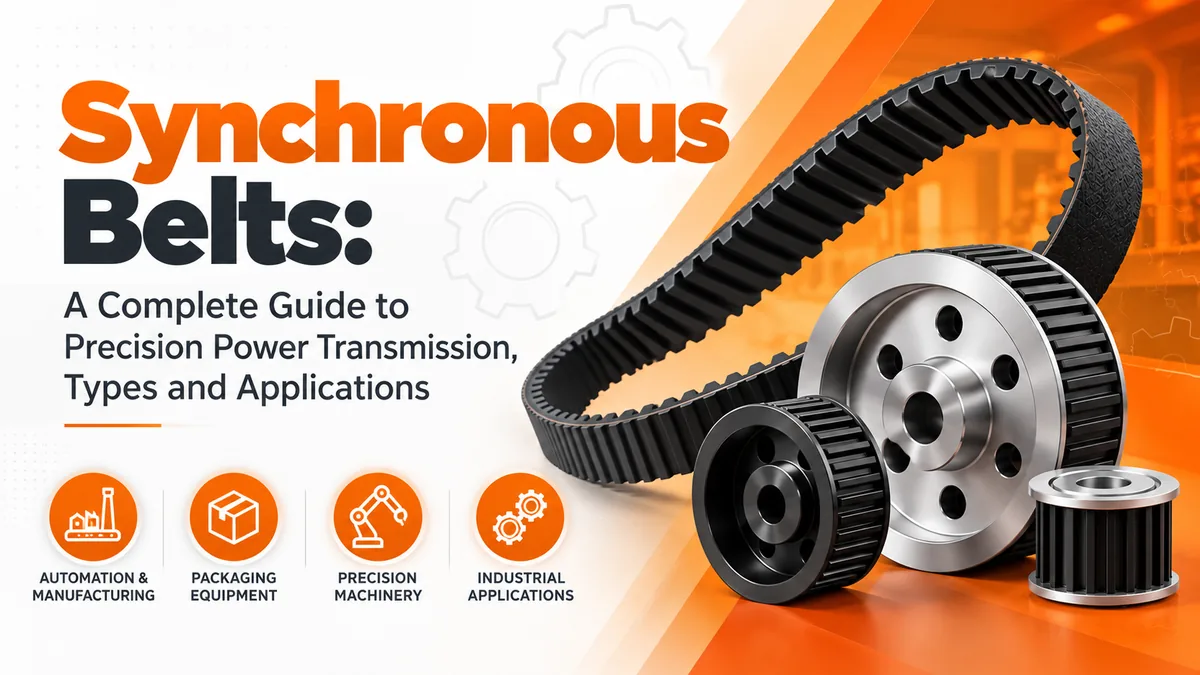
Modern industrial machinery requires reliable power transmission, accurate motion control and consistent operating performance. Synchronous belts play an important role in applications where precise timing and coordinated movement between rotating components are essential. Also known as timing belts, they use toothed engagement to transmit motion between compatible pulleys.
From automated production lines to packaging equipment and precision machinery, synchronous belts support controlled motion across diverse industrial applications. Their ability to maintain a defined speed relationship makes them suitable for synchronous belt drive systems that require repeatable performance.
Understanding their construction, working principles, advantages and selection criteria helps engineers and maintenance professionals identify the right belt for their equipment. Selecting a suitable belt can also support operational reliability, reduce avoidable maintenance issues and improve the performance of the complete drive system.
What Are Synchronous Belts?
Synchronous belts are toothed mechanical power transmission belts designed to transfer rotational motion through positive engagement with matching toothed pulleys. Unlike conventional V-belts, which transmit power primarily through friction, synchronous belts rely on the engagement between belt teeth and pulley grooves.
This mechanism helps maintain a consistent speed ratio between connected shafts when the drive is correctly designed, installed and operated. As a result, synchronous belts are widely considered for applications that require precision power transmission and synchronized movement.
A typical synchronous belt contains three principal elements:
- Belt body: Forms the belt structure and supports the teeth.
- Tensile cords: Reinforcement members that carry tensile loads and help maintain dimensional stability.
- Toothed profile: Engages with the pulley grooves to transmit motion and maintain synchronization.
Depending on the application, synchronous belts may use rubber or polyurethane-based constructions with suitable reinforcement materials. Different tooth profiles, pitches and belt widths are available to address varying power, speed and load requirements.
The belt must always be compatible with the corresponding pulley profile. Choosing the correct combination is essential for proper engagement, dependable operation and appropriate service life.
How Do Synchronous Belts Work?
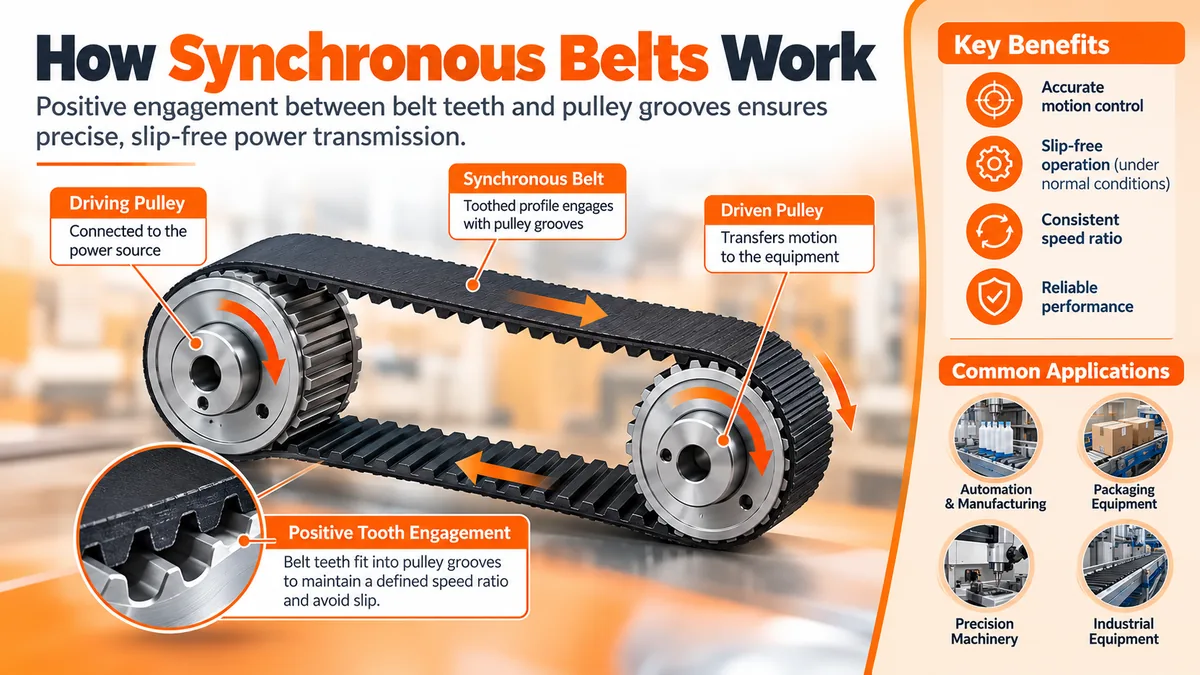
Synchronous belts operate through the positive engagement of teeth on the belt with matching grooves on the driving and driven pulleys. A typical arrangement includes a driving pulley connected to a power source, a toothed belt and a driven pulley that transfers motion to the required equipment.
When the driving pulley rotates, its teeth engage with the belt teeth, causing the belt to move. The belt then transfers this motion to the driven pulley through the same engagement mechanism.
Because the drive does not depend primarily on friction, it is designed to avoid normal operating slip and maintain a defined speed relationship between the shafts. However, excessive loading, incorrect tension or damaged teeth can cause tooth jumping and loss of synchronization.
The speed relationship depends on the number of teeth on each pulley. For example, if a driving pulley has 20 teeth and rotates at 1,000 RPM, while the driven pulley has 40 teeth, the driven pulley rotates at approximately 500 RPM.
This predictable transmission ratio makes Synchronous Belts suitable for machinery that requires coordinated motion, repeatable operation and controlled rotational speeds. Actual system accuracy also depends on pulley quality, belt characteristics, alignment and the mechanical design of the equipment.
Key Components of a Synchronous Belt Drive
A synchronous belt drive system depends on several compatible components working together.
Synchronous belt
Transfers motion through its toothed profile. Its construction, reinforcement, pitch and width must suit the application.
Toothed pulleys
Engage with the belt teeth and determine the transmission ratio according to their respective tooth counts. The pulley profile must match the belt profile.
Tensioning system
Maintains the required belt tension through the specified centre distance or an appropriate tensioning mechanism. Correct tension helps prevent tooth jumping and excessive belt movement.
Shafts and bearings
Support the pulleys and transmit mechanical loads. Incorrect alignment or excessive loading can affect the performance of the complete drive.
These components must be selected and installed as a compatible system. A suitable belt alone cannot compensate for incorrect pulley geometry, poor alignment or an improperly designed tensioning arrangement.
Types of Synchronous Belts
Synchronous belts are available in different tooth profiles and material constructions. Each design has specific characteristics, and selection should be based on the application requirements and the manufacturer's technical recommendations.
Trapezoidal-Tooth Synchronous Belts
These belts feature trapezoidal teeth and are used in various conventional timing and motion transmission applications. Their suitability depends on the profile, pitch, load and required operating accuracy.
Curvilinear-Tooth Synchronous Belts
Curvilinear profiles feature curved tooth geometry designed for particular engagement and load-transmission requirements. Depending on the specific design, they may be suitable for demanding industrial drives requiring appropriate load distribution and reliable tooth engagement.
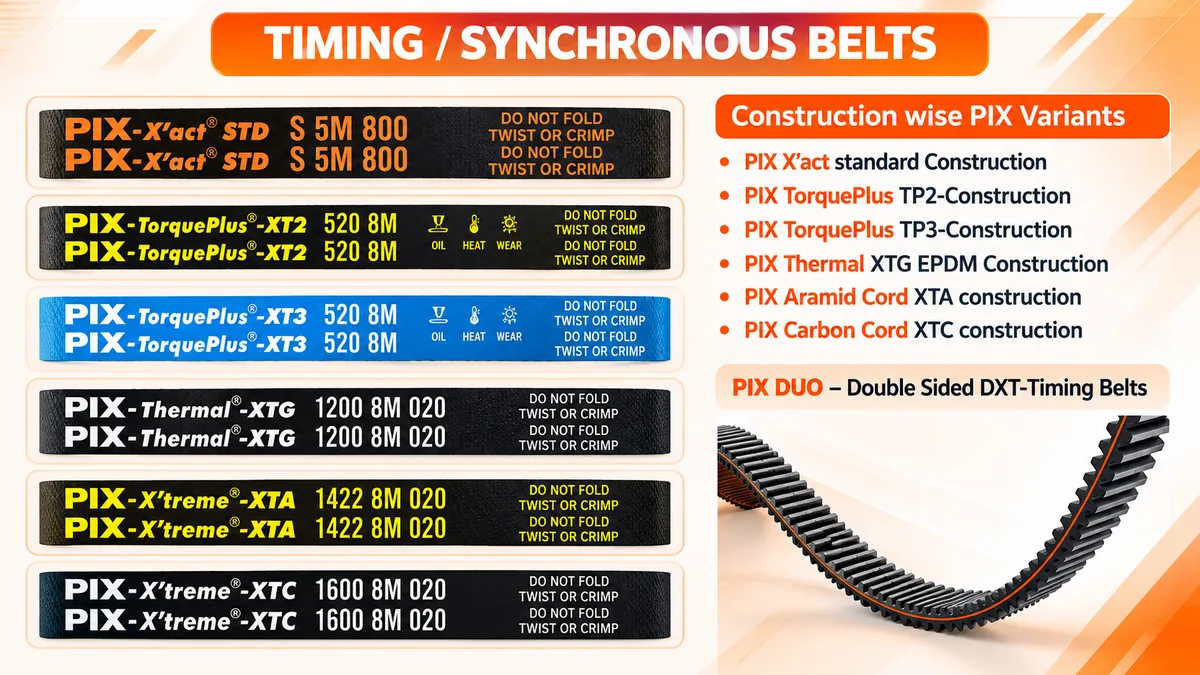
Rubber Synchronous Belts
Rubber synchronous belts commonly incorporate reinforcement cords to support tensile loading and dimensional stability. Different constructions are available for industrial and other mechanical power transmission applications.
Polyurethane Synchronous Belts
Polyurethane synchronous belts are used in selected applications requiring particular wear, dimensional or environmental characteristics. The suitability of a specific belt depends on its construction, reinforcement and operating conditions.
Single-Sided and Double-Sided Synchronous Belts
Single-sided belts have teeth on one surface, while double-sided belts have teeth on both surfaces. Double-sided designs can support drive arrangements where motion must be transmitted through both belt surfaces.
These types are not universally interchangeable. The correct profile, pitch, belt construction and compatible pulley design must be verified before installation.
Advantages of Synchronous Belts
Synchronous belts offer several benefits for industrial applications requiring controlled motion and reliable power transmission. They are frequently considered for precision power transmission applications where maintaining a defined relationship between connected components is important.
Accurate synchronization
Positive tooth engagement helps maintain a defined speed relationship between connected shafts, making synchronous belts suitable for applications requiring coordinated motion.
Reduced operating slip
Unlike friction-driven belts, synchronous belts transmit motion through tooth engagement. This helps prevent normal operating slip when the system is correctly selected and maintained.
Efficient power transmission
A properly designed synchronous belt drive can provide efficient transmission performance. Actual efficiency depends on the belt construction, pulley design, tension and operating conditions.
Reduced lubrication requirements
Synchronous belt drives generally do not require the routine lubrication associated with chain drives, simplifying certain maintenance activities.
Application flexibility
Different belt profiles, materials and dimensions support a wide range of machinery and operating requirements.
Support for precision applications
A high precision belt drive can help maintain controlled movement and repeatable transmission ratios. However, overall positioning accuracy also depends on the complete mechanical system, including pulley tolerances, belt characteristics and shaft alignment.
These advantages make synchronous belts a useful option for applications where timing, consistency and dependable operation are important.
Applications of Synchronous Belts
Synchronous belts are used across multiple industries where controlled motion and a defined relationship between rotating components are required.
Industrial automation
Automated production lines, indexing equipment and selected motion-control systems use synchronous belts to coordinate movement between components.
Packaging machinery
Filling, sealing, labelling and packaging equipment may use synchronous belt drives where consistent movement and timing are required.
Textile machinery
Synchronous belts support selected textile manufacturing processes involving coordinated rotating components and controlled mechanical motion.
Printing and paper handling
Certain printing and paper-processing systems use toothed belt drives to maintain synchronized movement.
Automotive applications
Synchronous belts are used in specific engine timing systems and other automotive mechanisms, depending on the vehicle design and manufacturer specifications.
Precision machinery
Belts for precision machinery may be selected for suitable positioning, indexing and synchronized-drive applications. The required level of accuracy depends on the complete machine design and the belt's technical characteristics.
Material handling
Suitable synchronous belts can be used in selected conveying and transfer systems where coordinated movement is important.
For each application, the belt specification must account for load, operating speed, environment and required performance. A belt intended for one application should not automatically be assumed suitable for another.
How to Select the Right Synchronous Belt
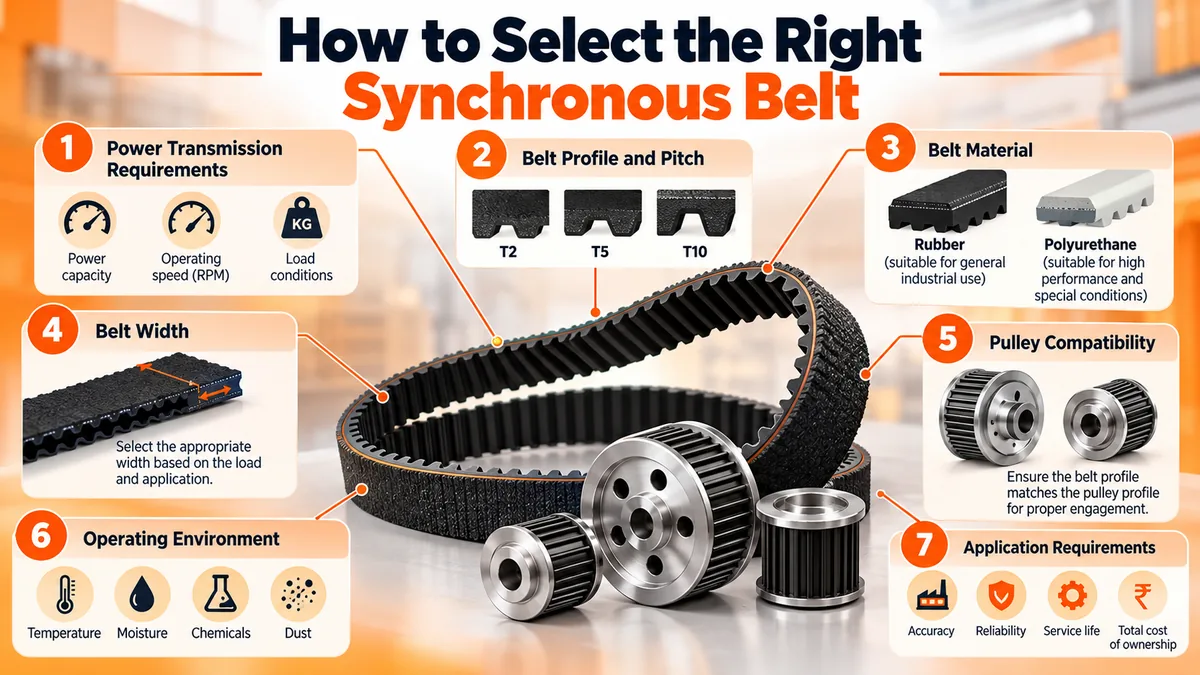
Selecting the correct synchronous belt requires an assessment of the complete drive system rather than simply matching the existing belt's appearance.
1. Determine Power and Torque Requirements
Identify the transmitted power, torque, rotational speed, starting conditions and load variations. Frequent starts, sudden load changes and shock loads can influence belt selection.
2. Confirm Tooth Profile and Pitch
The tooth profile and pitch must match the pulley geometry. Incorrect combinations can result in poor engagement, excessive wear and premature failure.
3. Calculate Belt Length and Width
Belt length depends on the pulley diameters or tooth counts and the distance between pulley centres. Belt width must be appropriate for the transmitted load and the manufacturer's rating.
4. Evaluate Operating Conditions
Consider temperature, moisture, dust, oil, chemicals and other environmental factors. These conditions can influence the choice of belt material and reinforcement.
5. Assess Precision Requirements
For a high precision belt drive, consider the required speed consistency, repeatability, positioning accuracy and permissible mechanical tolerances. Belt characteristics must be evaluated alongside pulley accuracy and system stiffness.
6. Check Alignment and Tension
Incorrect pulley alignment or tension can contribute to noise, wear, excessive loading and tooth jumping. Follow the equipment manufacturer's installation and tensioning procedures.
7. Consult Technical Documentation
Use the belt manufacturer's selection tables, engineering data and application guidance to verify the final specification. When replacing an existing belt, confirm its part number and dimensions rather than relying only on visual similarity.
A properly selected belt and compatible pulley arrangement help support reliable operation and reduce avoidable maintenance problems.
Common Problems and Maintenance
Synchronous belt performance depends on correct installation, suitable operating conditions and regular inspection. Several common issues can affect service life.
Excessive or insufficient tension
Incorrect tension can increase mechanical loading or allow tooth jumping. Follow the manufacturer's specified tensioning procedure.
Pulley misalignment
Misaligned pulleys can cause uneven wear, tracking problems and damage to belt edges. Check shaft and pulley alignment during installation and maintenance.
Tooth wear or damage
Worn pulley grooves, excessive loads and incompatible belt profiles can damage belt teeth. Inspect both the belt and pulleys when investigating a failure.
Contamination and environmental exposure
Unsuitable oils, chemicals, heat or debris may affect belt materials. Use a construction suitable for the operating environment.
Improper installation
Forcing a belt over a pulley or using unsuitable installation tools can damage its structure. Follow the manufacturer's recommended installation procedure.
Routine maintenance should include visual inspection, checking alignment and tension where appropriate, and investigating unusual noise, vibration or changes in operating performance. Always isolate the equipment and follow applicable safety procedures before inspecting or servicing the drive.
Replacing a damaged belt without correcting the underlying cause may lead to another premature failure.
Conclusion
PIX Transmissions Ltd. offers a range of mechanical power transmission products, including timing/synchronous belts for industrial and other suitable applications. The company's synchronous belt range can be explored through its official product page.
When evaluating a belt for a specific application, consider the required tooth profile, pitch, length, width, operating conditions and compatibility with the existing pulley arrangement. Refer to the relevant product documentation and obtain technical guidance where required.
Looking for a suitable synchronous belt for your application? Explore the PIX Timing / Synchronous Belts product range and contact PIX Transmissions Ltd. for product information and application-specific assistance.
Need the right synchronous belt for your application? Explore PIX Synchronous Belts and get expert assistance from PIX Transmissions Ltd.
Explore Synchronous Belts